
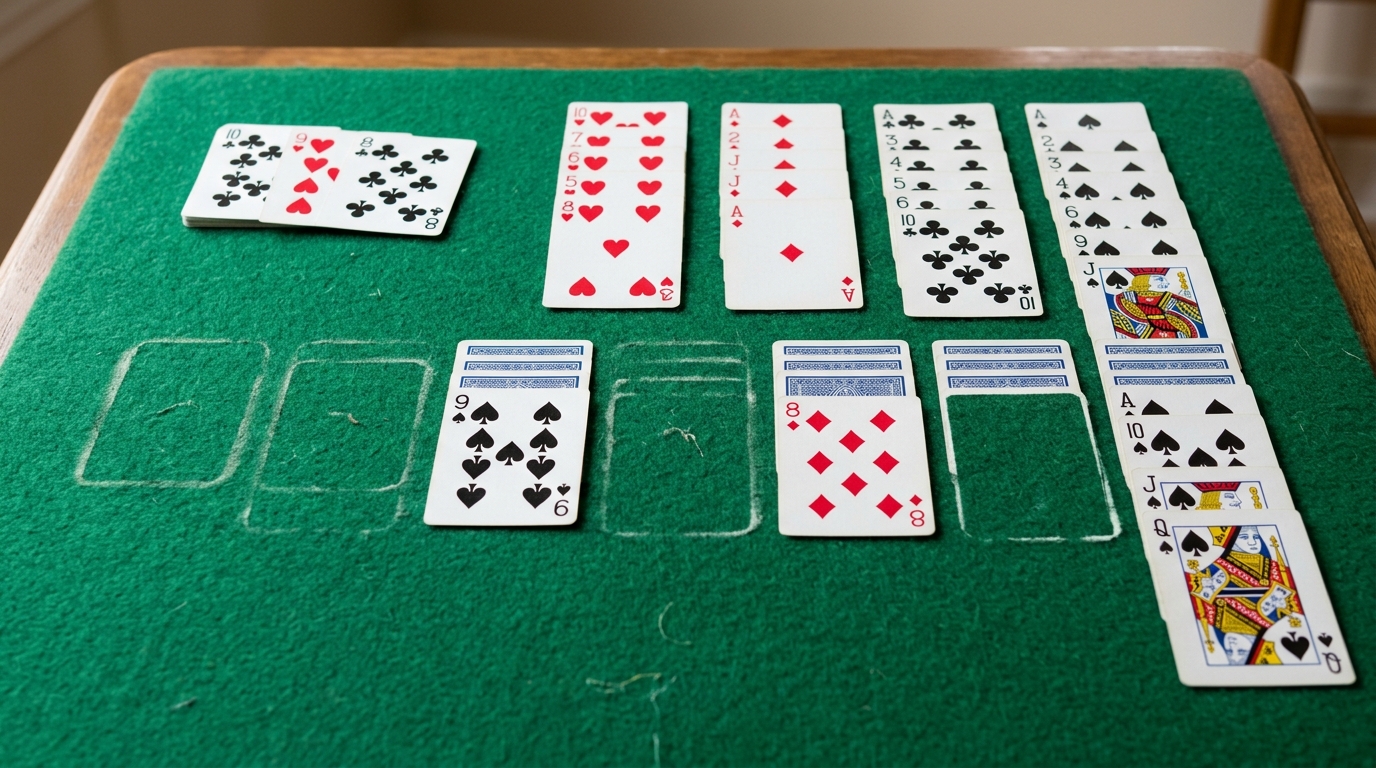
A timed Solitaire game punishes the move you have to repair twice. The best speed practice is often a slower-looking decision that keeps the tableau readable. Solitaire timed accuracy gives that moment a name, but the useful part is the habit behind it. The aim is not to make every move look clever. It is to make the next move easier to explain.
The Windows Solitaire history and Bicycle Solitaire rules provide useful background for the timed routine.
Why Solitaire timed accuracy matters on an ordinary puzzle
Solitaire timed accuracy appears in score challenges, daily games, and friendly races even when the format is informal. The useful skill is not memorizing one perfect sequence. It is reducing hesitation around obvious moves while refusing guesses that create a larger repair later. A player does not need a special setup to use this idea. It works during a short browser session, on a printed page, or in the middle of a game when attention is starting to drift.
Klondike Solitaire rewards players who read the tableau as a set of doors. Some cards open a face-down card, some create a lane, some free a low card, and some only make the piles look nicer. The stock can help, but it can also hide the card you need behind a less useful one. A calm player does not reject progress; they ask whether the progress improves access. That small distinction is what turns a legal move into a well-timed move.
The wider background is worth keeping nearby. Bicycle Solitaire rules offers useful context for this puzzle family, while Parlett patience history gives a second view of its rules or history. The sources differ in purpose, but both support the same practical lesson: a clear structure gives the player something reliable to inspect.
How to use Solitaire timed accuracy without forcing it
Use a short priority order: reveal a face-down card, create a useful tableau move, expose a playable waste card, then advance the foundation when it does not remove flexibility. Keep doubtful moves reversible and reserve the final seconds for checking the highest-risk stack. Start with a legal move and let the evidence narrow the field. If the position does not improve, stop. A good technique is a filter, not a command to keep pushing the same idea after the board has moved on.
A short routine for the next game
Practise in two rounds. Play the first round without a timer and name the priority behind each move. Play the second with a short timer, but keep the same order. Compare repairs rather than only the final time.
- Reveal a hidden card when the cost is low.
- Preserve flexible tableau destinations.
- Use the stock with a remembered purpose.
- Review repairs after the timed game.
The mistake that makes this idea feel harder
The trap is measuring speed by clicks. Another mistake is moving every legal card immediately and losing track of the stock order. Accuracy under time pressure comes from a stable priority order, not from making the board change constantly.
What to remember when the board changes
Solitaire timed accuracy turns speed into a quality of attention. A clean move saves the seconds you would otherwise spend undoing, rechecking, or rebuilding a column. That is also why Solitaire timed accuracy should stay practical. Use it when it describes the board in front of you, then return to ordinary reading when the evidence changes. A puzzle is allowed to ask a different question on the next move.
If Solitaire timed accuracy does not produce a move today, that is useful information too. Leave the position clean, keep the strongest clue visible, and come back after one ordinary move. Techniques become reliable through that small return: notice the signal, test it, record what changed, and stop before the idea turns into a guess. Over time, the pause becomes part of your solving rhythm rather than a sign that the puzzle has defeated you.
Keep the session concrete. Name the clue, make one reversible change, and look again. That is enough for a useful practice round, even when the puzzle is unfinished. A short note about what changed makes the next session easier to start.
For a live session, play more puzzles on 3-card-solitaire.com. When you want a related example, browse related posts on this site. You can also try another daily puzzle at Easy Daily Puzzle or find more puzzle guides on Easy Daily Puzzle. Keep the next step simple: play one puzzle, try the routine once, and notice which decision became clearer.
A Solitaire deal is easier to revisit when the last move had a reason. Remember the hidden card, lane, or stock position you were protecting, then continue from that point instead of replaying the whole board emotionally.