

You remember the first big memories when you had a birthday party outside or met Arnold’s pet dog for the first time. You view these as core experiences, but you may not realize that you have to understand them as a child before they can become part of your own image.
Born to age five is the first time a child develops memories and perceptions of himself, but there are many things you can do to promote positive development in the past. One of the easiest and most fun ways to develop memory is through games that test your children and teach them basic skills.
Memory games for children are a great way to promote self-development and to build lifelong skills.
The screen has been closedName
Memory is the ability to store minds and store information. This skill does more than affect the possibility of remembering a school event, or recalling a past event, such as birthday. Memory defines how a child thinks, learns and it helps shape the development of language skills, ability to solve problems, and how they envision the world. It can even allow children to start developing completely new skills such as cycling.
Let us consider some skills related to memory.
Languages and Texting
The ability to speak and read is important for a child to understand the world around him and develop memory. And when you tell and repeat past stories, you create a way for your children to collect details about the events and express their own feelings. They will then begin to view future experiences with the same type of content. This gives them a way to look inside and understand his thoughts and selfs.
Solve Problems
In addition to defining and explaining their own experiences, children can also learn to solve problems through their memory development. When faced with experience or circumstances with familiar factors, they can draw from the past and use them to help them cope with the present. Children are especially good at drawing from these relationships and studies that show that children are more successful at recalling than adults.
Can not open message
You may not realize it, but the imagination does not just appear in your child’s brain every day. The imagination needs to come from archived information combined in a new way to create new information. And children need to keep growing that inventory. You can also try to feed that imagination through things like materials, materials, games, or material in the past like photographs that can evoke connection with memory and form ideas that are completely new.
The Benefit of Memory Games for Children

This brings us to memory games, fun and educational ways to encourage cognitive development for your children.
Memory games also promote neural change – brain capacity for change and adaptation based on experience. The game can help children learn to remember, recognize, and remember information in an entertaining way. Moreover, they can also help to improve their focusability, improve problem solving skills, and increase memory ability.
Focus is better.
When children play memory games, they need to focus on a specific job. But also depending on the game, they will be required to remember certain items, numbers or symbols and apply those details in the game for the first time. Usually, they need to give a set of laws, which require higher concentration. Memory games require high concentrations that can directly translate to improve attention for your child.
A Better Problem Solution Skill
Focus is one thing, but memory games also create broader opportunities for your child to create and learn to solve problems. Memory games give children the freedom to explore different greetings as they discover how to always succeed.
Memory games are not just attention, they also provide opportunities for a child to create and learn to solve problems. Memory games give children freedom to explore different solutions as they discover how to always succeed. By playing memory games, children must develop the ability to face and meet a problem.
Synchronising folder
It may seem self-explanatory to say that memory games are useful for remembering memories, but these games exist as testes to remember details. Personal games are based on the ability to recall information related to rules or something entirely related to experience. Playing memory games can help them read better, store better information and recognize information patterns. It has been shown that children are regularly involved in memory games that show improved skills in pattern identification and the ability to concepts of information related to images, maps and objects.
The screen has been closedName
There are many options for memory games, but the important thing is to make the right choice for your children. Consider what skills are needed for a personal game, and if your child is willing to apply them.
Education and Age
When choosing memory games for your children, it is important to consider the level of difficulty offered when referring to who is the goal of the game. You do not want to choose something higher or lower than your child’s education level on the level of education and age. Also, you want to make sure that it is not too inappropriate or that it may be considered boring or having children.
Screen time limit
In addition to finding suitable games for your children, it is important to set rules in order for your children to play these games. According to Mayo Medical Systems, elementary students spend more than two hours watching television, playing video games, or computers often have emotional, social, and attention problems. With this in mind, you should make sure that some games do not have a screen and see how long the child plays these games.
Make Habits
Another thing to consider is that, like any exercise, building memory requires consistent work. Memory games are only useful if they have habits and moderation. If you allow your child to play too much memory games, you will not have room to learn more. And if they don’t play enough, it won’t help them. That’s an important reason to establish habits and ensure that playing memory games becomes a positive, healthy habit.
The best online and external memory game for children

We talked about the benefits of memory games in general, so now we can talk about some specific examples of educational play. The following are some of the games that children can play online or turn off the machine depending on what you want them to do and what suits their needs.
Offline Memory Game
Video games are an easy way to introduce children to memory games. They’re easy to play, and good to play. Here are three off-line memory games for you to start:
The screen has been closedNameYou just need three cups and a ball or coins for this classic game. First, put the upside-down cup on the table and put the ball or the coin under the cup. Make sure your child sees the location of the object and then moves around the cups. Then tell me which cup is below. This game tests their focus and memory.
Soundline‹ Sit down with your children or children, and start by creating a sound sequence (such sounds as finger grabs, claps, slaps, pats your head) that you then ask them to repeat in sequence before adding another sound. Just keep walking back and forth until someone misses.
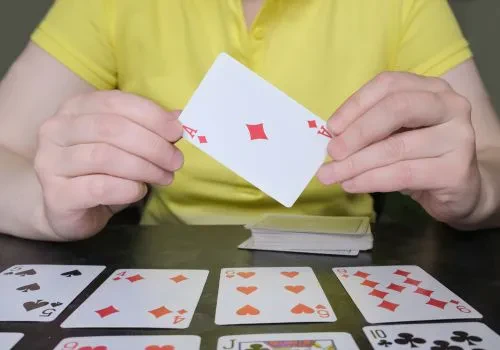
Quick Tag: There are several different ways to play cards. Whether you buy a deck of cards with specific matches or create your own options, make sure you have a corresponding set of cards. Then, put the cards upside down in a 2×2 or 3×3 face grid down. Go back and forth and try to pick the right card based on their memory of the place of the card.
Online Memory Game
Simon Online – based on the popular game of the same name, this online game lets the player view a color sequence and then asks them to repeat the same pattern. The game begins with only one color, but it can last as long as your child can repeat the pattern.
Counting sheep 2 – This devious memory game requires players to monitor the number of sheep coming in and out of a barn. It may sound easy, but it quickly becomes complex as the number of vibrations and the sheep disappear.
Playing cards… This classic game is one of the best and easiest ways to help your child remember. In this online game, the player will be tested to build the arithmetic sequence with the cards and solve the problems that come with the game arrangement.
Memory is muscle for exercise
These are just a few ways you can use the game to help your child develop memory. But it is important to remember that memory games are not fully effective without routine. Your child’s memory requires regular care and even a game of Seneca every day can help his brain to function high and his memory to function best.